Plot in Dholera: Complete Legal & Site Verification Checklist Before Buying
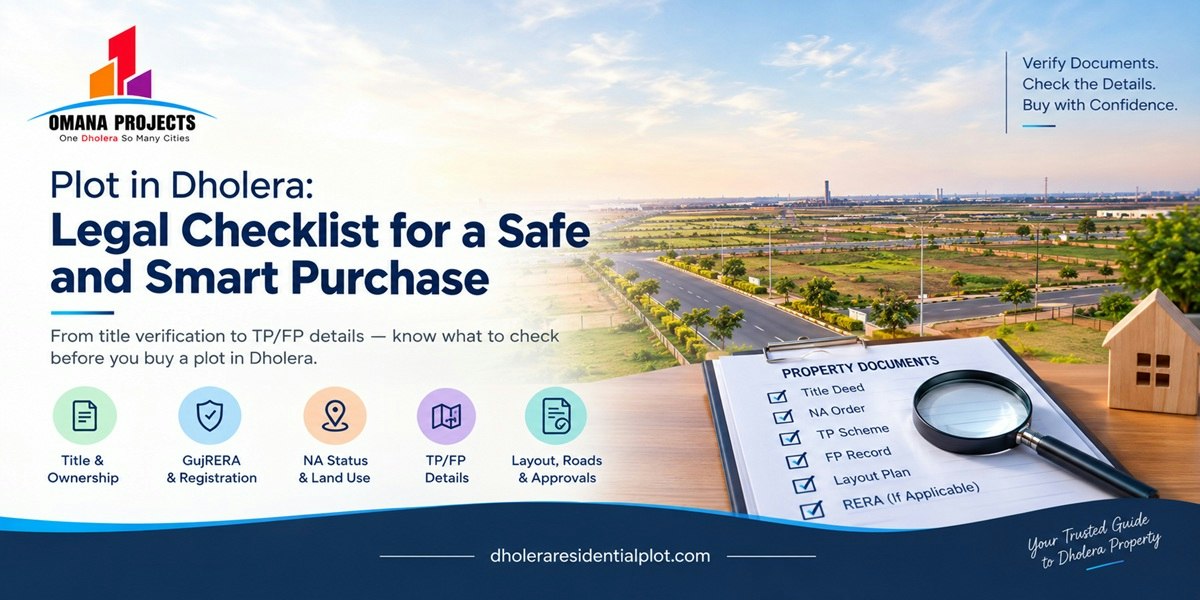
Buying a Residential Plot in Dholera can look straightforward when the location, plot size and price appear attractive, but land transactions require a deeper verification process. Dholera is a large planned development region rather than a single conventional residential locality. The Dholera Special Investment Region covers about 920 sq. km across 22 villages, with its developable area organised through Town Planning Schemes of Dholera SIR and an Activation Area that combines multiple land uses. For this reason, a buyer should verify the exact identity, land use, planning status and access of a property instead of relying only on a brochure, map location or sales description.

1. Start With Ownership and Title
The first question should be who legally owns the land being offered for sale? Ask for the title documents and examine the ownership history before paying a substantial booking amount. A proper title investigation can help identify previous transfers, mortgages, disputes, claims or other encumbrances.
Buyers should not treat phrases such as “clear title” or “legally verified” as a substitute for seeing the underlying documents. An independent property lawyer can examine the title chain and relevant revenue records and provide an opinion based on the actual property. This step is particularly important when buying a plot because the buyer is acquiring an interest in land rather than a completed building.
2. Verify NA Status and Permitted Land Use
The next check is the property's land-use status. If a plot is being marketed for residential, commercial, SCO or mixed-use development, the buyer should verify that the applicable documents support the intended use. Non-Agricultural (NA) documentation may be relevant depending on the land and transaction.
Do not assume that a plot described as “residential” in an advertisement automatically has every permission required for construction. Check the applicable NA order or land-use documentation, along with the relevant planning records. The reference material highlights Collector-level NA documentation as one of the key checks, but the exact documents applicable to a particular property should be confirmed professionally rather than applying one checklist mechanically to every transaction.
3. Match TP, FP and Layout Records
For a Plot in Dholera, the TP and FP details deserve particular attention. Official Dholera planning material describes the SIR as being divided into six Town Planning Schemes (TP1, TP2, TP3, TP4, TP5, TP6), with TP1 and TP2 forming part of Phase I and TP2 further divided into east and west sections for implementation.
Ask for the relevant TP information, Final Plot details where applicable, plot number, dimensions and approved layout. Then compare those details with the property being physically shown to you. A marketing layout should not be treated as the final authority unless it corresponds with the applicable sanctioned or official records.
4. Inspect the Plot on the Ground
Paperwork alone is not enough. A physical site inspection should form part of the buying process. Visit the exact location and check whether the plot shown to you corresponds with the documents. Confirm boundary markers, neighbouring plots, approach roads, plot dimensions and the surrounding development.
If possible, have the plot location checked using the relevant survey or demarcation information rather than simply accepting a dropped map pin. The reference checklist also recommends checking physical plot markers and road access during a site visit. This can help identify situations where the advertised location and the actual parcel require further clarification.
5. Check Road Access and Surrounding Infrastructure
A plot's value and usability are affected by how it can actually be accessed. Buyers should verify the approach road, internal road, road width and connection with the broader road network. Do not rely solely on a claim such as “70-metre road” or “main road property”; confirm the relevant measurement and its status in the applicable layout or planning documentation.
Also examine nearby electricity, water, drainage and other infrastructure. Dholera's official development framework includes trunk infrastructure and multiple land uses within the planned region, but infrastructure at the SIR level does not mean every individual plot has identical access or utility availability.
6. Understand RERA Before Assuming Anything
RERA status should be checked according to the particular project structure. Buyers should not automatically conclude that every plotted project requires registration or that every plot is exempt. The relevant question is whether the particular development falls within the applicable RERA requirements and whether any exemption applies. If a seller says registration is not required, ask for the basis of that position.
If registration is applicable, verify the project details through the appropriate regulatory records. More importantly, remember that RERA verification does not replace title, land-use, TP/FP or layout verification. These are separate aspects of property due diligence. The reference article specifically identifies RERA status alongside layout, NA and title checks.
7. Compare the Property With Its Actual Purpose
Not every Residential Plot in Dholera should be evaluated using the same criteria. A residential buyer may prioritise neighbourhood development, utilities, access and future construction. An SCO or commercial buyer may place greater importance on frontage, road visibility, permitted use and customer accessibility. Such project-specific details demonstrate why buyers should compare the exact TP/FP position, plot size, road access and intended use rather than comparing properties solely by their headline price.
8. Complete the Legal Review Before Booking
The safest sequence is simple: identify the property → verify ownership → check land use and NA status → verify TP/FP and layout → inspect the site → confirm road access → check applicable RERA requirements → review the agreement → then proceed with registration. Keep copies of the documents supplied during the transaction and have important agreements reviewed before signing. A good property decision is not simply about finding a Plot in Dholera at an attractive price; it is about establishing that the particular plot matches the documents, planning framework and intended use.
FAQs
1. What should I verify first before buying a Plot in Dholera?
Start with ownership and title. Then verify land-use status, NA documentation where applicable, TP/FP information, layout approval, road access and the physical identity of the plot.
2. What is a title search?
A title search examines the ownership history and relevant property records to identify possible claims, transfers, mortgages, disputes or other issues affecting the land.
3. Is NA status important for a Dholera plot?
Yes. Buyers should establish the applicable land-use status and verify the relevant NA documentation where required for the particular property and intended use.
4. Why should I check TP and FP details?
TP and FP information helps establish the property's position within Dholera's planned development framework. It can also help buyers compare the advertised plot with official planning and layout information.
5. Should I physically visit the plot before purchasing?
Yes. A site visit allows you to compare the actual location with the documents and check boundaries, roads, neighbouring development and accessibility.
6. How can I verify the road shown for a plot?
Ask for the applicable approved layout or planning documents and compare the stated road width and access with what exists at the site.
7. Does every Plot in Dholera require RERA registration?
RERA applicability depends on the particular project's structure and the provisions and exemptions under the law. Buyers should verify the project's specific regulatory position rather than making a blanket assumption.
8. Is a developer's legal verification certificate enough?
It is useful as supporting information, but buyers should still conduct independent legal due diligence. An independent advocate can examine the title and documents from the buyer's perspective.
9. What documents should I keep before booking a plot?
Keep copies of ownership/title documents, applicable revenue records, NA documentation, TP/FP details, approved layout, plot details, road information, RERA information where applicable and the proposed agreement.
10. Can I buy a plot only by checking its location on Google Maps?
No. A map can help locate a property, but it does not establish ownership, land-use status, TP/FP identity, approvals or legal access. Those details require document and site verification.