Power of Attorney for NRIs Buying Property in Gujarat: Process, Documents and Risks
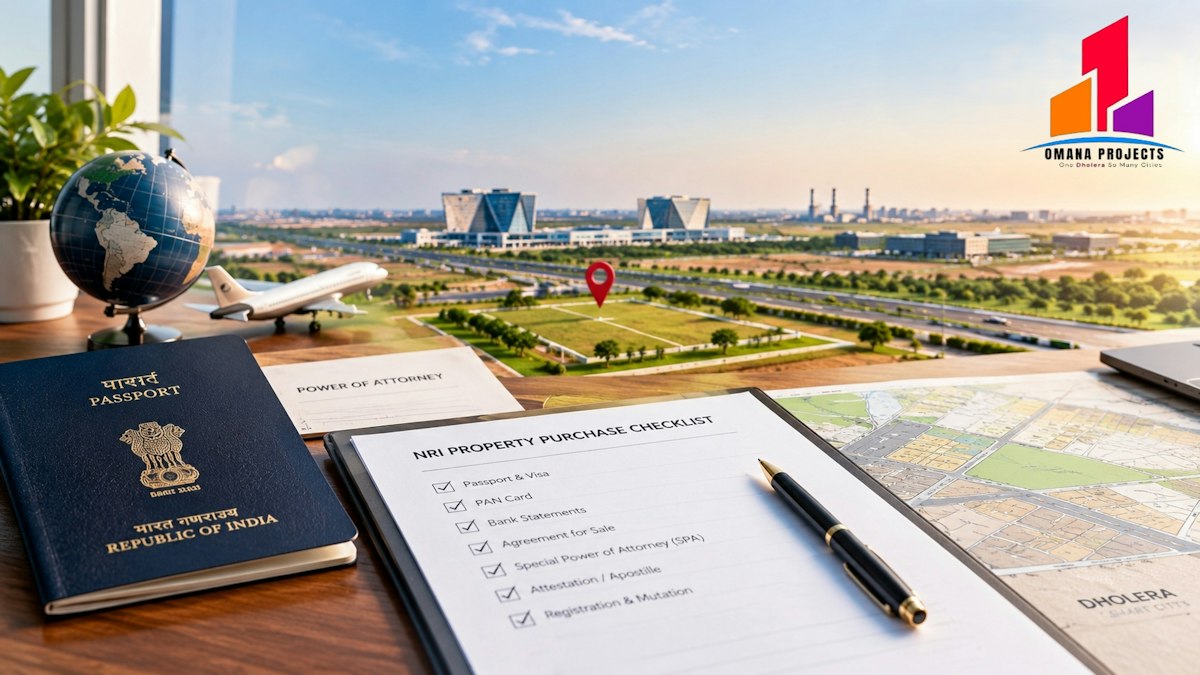
Buying property in Gujarat while living abroad can involve practical challenges. An overseas buyer may not be able to attend every meeting, inspect every document in person or travel to India for each stage of the transaction.
A Power of Attorney (POA) can allow an authorised representative in India to perform specified tasks on the buyer’s behalf. For NRIs considering plots in Dholera, this can make the transaction more manageable—but only when the authority is drafted correctly, the relevant formalities are completed and the underlying property is independently verified.
A POA does not automatically establish ownership, guarantee that a sale is valid or remove the need for legal due diligence. This guide explains how it works, what documents to prepare and which mistakes to avoid when purchasing property in Ahmedabad Gujarat from overseas.
This article provides general information, not individual legal advice. Requirements depend on the document, the transaction and the circumstances of the parties. Consult a Gujarat property lawyer before signing or using a POA.
What Is a Power of Attorney?
A Power of Attorney is a legal instrument through which one person authorises another person to act on their behalf within the powers specified in the document.
In a property transaction, the person granting the authority is commonly called the principal, while the person receiving it is the attorney-holder or agent.
For example, an NRI living in Canada may authorise a trusted representative in Gujarat to coordinate document collection, communicate with a lawyer or perform other expressly permitted tasks related to a proposed plot purchase.
The representative's authority depends on the wording of the POA and applicable law. A document that permits someone to collect records does not necessarily authorise them to sign a sale deed, accept possession or make payments.
Why Might an NRI Need a POA to Buy Property in Gujarat?
A POA may be useful when the buyer cannot travel to India for every part of the transaction.
Depending on its wording and the requirements of the relevant parties, it may authorise a representative to:
Obtain property-related documents.
Communicate with the seller, lawyer or other professionals.
Coordinate site inspections and verification.
Sign specified applications or transaction documents.
Complete permitted administrative formalities.
Attend registration-related proceedings where legally authorised.
These activities are not automatically included in every POA. The document should clearly state what the representative may do and whether any action requires the principal's prior written approval.
If the buyer can attend the critical stages personally, a POA may not be necessary for every task. The appropriate arrangement depends on the transaction and the buyer's circumstances.
General POA vs Special POA for Property Purchase
Two common forms of authority are a General Power of Attorney and a Special Power of Attorney.
General Power of Attorney
A General Power of Attorney may authorise a representative to handle a broader range of matters listed in the instrument.
A broad authority can be convenient when someone needs continuing assistance with multiple affairs. However, it can also create unnecessary risk if the representative receives powers that are wider than the buyer intends to grant.
Special Power of Attorney
A Special Power of Attorney is generally designed for a specified transaction or limited set of actions.
For a buyer considering a particular plot in Dholera, a carefully drafted special POA may be preferable where the intention is to authorise only defined tasks for that purchase.
It can identify the property, state the authorised actions, establish limits on payments and specify whether the representative may sign particular documents.
The legal effect depends on the document's wording and applicable law; the label alone does not make a POA valid or sufficient for registration.
What Powers Should a Property POA Include?
The POA should match the actual tasks the NRI needs the representative to perform.
Depending on the transaction, the lawyer drafting the document may consider including clearly defined authority for the following matters.
1. Property Identification
The document should identify the property as precisely as possible. Relevant details may include the village, survey number, plot number, applicable Final Plot number and other identifiers available for the specific property.
Do not rely exclusively on a marketing name or a general description such as “a plot near Dholera.”
2. Document Collection and Verification
The representative may be authorised to obtain specified documents and coordinate their review with an independent lawyer.
The authority should not be treated as permission to accept unverified documents or waive important due-diligence requirements.
3. Signing Transaction Documents
If the representative is expected to sign an agreement, deed or other instrument, the POA must expressly and appropriately authorise the relevant act.
Do not assume that authority to negotiate a purchase also authorises execution of the final conveyance deed or admission of its execution before a registering officer.
4. Payment Authority
If the representative must handle any payment, define the scope and limits carefully. Consider whether payments should be made directly by the buyer through normal banking channels and whether the representative needs any authority to receive funds.
Avoid giving unrestricted control over purchase funds when a narrower arrangement would meet the requirement.
5. Registration-Related Authority
If the representative will present documents or act in connection with registration, the POA must meet the requirements applicable to that role.
Section 33 of the Registration Act, 1908 sets out categories of powers of attorney recognised for purposes covered by Section 32, including authentication requirements for certain instruments executed by principals residing outside India. The registering office and the property's circumstances should be checked before relying on a document. Read Section 33 of the Registration Act.
How Can an NRI Execute a POA While Living Abroad?
The process depends on the country where the NRI resides, the method of authentication, the intended use of the document and the requirements of the relevant Indian registering office.
A practical sequence is set out below.
Step 1: Consult a Gujarat Property Lawyer
Before signing anything, explain the proposed purchase and identify the tasks that need to be handled in India.
The lawyer should review the property details and draft or approve the POA wording. If the document will be used for a registered conveyance, confirm the requirements with the relevant Sub-Registrar's office before execution abroad.
Step 2: Prepare the Draft
The draft should identify the principal and representative, describe the property and set out the powers being granted.
It should also address limits on authority, the duration or completion of the assignment, and the circumstances in which the authority may be revoked or otherwise cease to operate.
Avoid downloading a generic POA template and signing it without checking whether it meets the requirements of the intended transaction.
Step 3: Complete the Applicable Authentication Formalities
Section 33 of the Registration Act, 1908 recognises specified forms of authentication for powers of attorney used for the purposes covered by that section. For a principal residing outside India, the statutory text includes execution before and authentication by specified persons or authorities, such as a Notary Public or an Indian Consul or Vice-Consul. See the statutory provisions.
The precise route and supporting requirements should be confirmed for the country of residence and the intended transaction. Depending on the circumstances, consular procedures, notarisation, apostille or other authentication requirements may need to be considered.
Do not assume that notarisation alone will satisfy every requirement.
Step 4: Send the Original Document to India
If the transaction requires the original POA, arrange secure delivery to the authorised representative or lawyer.
Keep a complete copy and record the document's execution and delivery details. The representative should not be allowed to alter the signed document or use it for a different transaction.
Step 5: Confirm Gujarat Stamp Duty and Adjudication Requirements
A POA executed abroad may need to meet applicable Indian and Gujarat stamp-law requirements before it can be used.
The applicable duty, any deadline for stamping or adjudication and the process for regularising the document should be checked with a Gujarat lawyer or the relevant authority. Do not assume that the amount or procedure is identical for every POA.
Step 6: Confirm Acceptance Before Registration
Before scheduling a registration appointment, ask the relevant Sub-Registrar's office or legal adviser to confirm that the POA is acceptable for the intended act.
The representative may need to provide identity documents, the original POA and other supporting records. Requirements can vary with the document and transaction.
Completing these steps in advance can reduce the risk of a delay caused by an incomplete or unsuitable authorisation.
Documents an NRI Buyer Should Prepare
The documents required will depend on the principal, representative, property and transaction. A preliminary checklist may include:
Passport or other accepted identity documents.
Overseas address and contact details.
PAN details where required for the transaction.
Identity and address documents for the representative.
The drafted and duly executed POA.
Authentication evidence and any required supporting certificates.
Applicable stamping or adjudication records.
The proposed property's survey, plot or other land identifiers.
Relevant title, ownership and land-use documents.
The draft agreement or conveyance deed.
Payment and remittance records relevant to the purchase.
This is a preparation list, not a complete statutory list for every case. Ask the lawyer and relevant registration office to confirm the exact requirements before execution or registration.
Can an NRI Buy Any Type of Land Through a POA?
No. A POA does not remove restrictions that may apply to the buyer or the property.
Under India's foreign-exchange framework, NRIs and eligible Persons of Indian Origin may generally acquire residential and commercial property under the applicable rules, but agricultural land, plantation property and farmhouses are subject to restrictions and different requirements. The buyer's precise status and the property's legal classification must be checked. See the Ministry of External Affairs' guidance on acquiring immovable property in India.
For a purchase Plots in Dholera by NRI or a nearby village, verify the land classification and applicable permissions independently. Do not rely only on the seller's description of the property.
Risks of Using a POA for a Property Purchase
A POA can simplify administration, but an incorrectly drafted or misused document can expose the buyer to significant risk.
1. Giving Excessive Authority
A broad POA may grant powers that are not needed for the intended purchase.
Precaution: Limit the powers to the specific transaction and actions required. Define any financial authority clearly and obtain independent legal advice before granting authority to sell, transfer, mortgage or otherwise dispose of property.
2. Incorrect Property Details
An unclear property description may create confusion about which land the representative is authorised to deal with.
Precaution: Use the identifiers supported by the relevant records and have the description checked against the proposed transaction documents.
3. Assuming the POA Proves Ownership
A POA establishes authority to act within its scope; it does not by itself establish that the seller owns the property or that the buyer has acquired title.
Precaution: Independently verify the seller's title, chain of ownership, encumbrance-related information, applicable permissions and the property's identity.
4. Unauthorised Payments
A representative may be given access to money or permitted to make commitments beyond the buyer's intentions.
Precaution: Define payment authority and limits. Where practical, have purchase consideration transferred through appropriate banking channels with clear records identifying the recipient and purpose.
5. Failure to Confirm Registration Requirements
A POA that appears properly signed may still be unsuitable for a particular registration-related task if the applicable authentication, stamping or wording requirements have not been met.
Precaution: Obtain confirmation from a qualified Gujarat property lawyer and the relevant registration office before relying on the instrument.
6. Unclear Revocation or Expiry
The principal may need to withdraw authority or replace the representative. The effect of revocation, notice to affected parties and any pending transaction must be handled properly.
Precaution: Ask the lawyer to explain how the authority may be revoked, what notices are required and how the representative's authority will be communicated to relevant parties.
A Special POA Checklist for Dholera Plot Buyers
Before authorising someone to purchase a plot, confirm the following:
The representative's identity has been independently verified.
The exact property has been identified through relevant records.
The seller's authority and title have been reviewed.
The POA clearly authorises the tasks the representative will perform.
Any signing, payment and registration powers are specifically addressed.
Authentication and stamping requirements have been checked.
The relevant Sub-Registrar's office requirements have been confirmed.
The buyer will receive copies of documents, receipts and registration records.
The representative is required to report significant actions and payments.
The POA's duration and revocation procedure are understood.
If the property is described as being inside Dholera SIR, near a TP scheme or close to major infrastructure, verify those claims against relevant official records. Proximity to Dholera SIR does not by itself establish that the plot lies within the notified boundary.
Frequently Asked Questions
Can an NRI buy a plot in Gujarat without travelling to India?
A representative may be able to handle specified tasks under a properly executed POA. Whether the buyer must personally attend a particular stage depends on the transaction and applicable requirements. Confirm the process with the relevant lawyer and registration office.
Is a notarised POA from abroad always sufficient?
No. The applicable authentication, stamping and registration-related requirements depend on the document and its intended use. Confirm them before signing and sending the document to India.
Should I use a General or Special Power of Attorney?
The choice depends on the tasks being delegated. A narrowly drafted Special Power of Attorney may be suitable for a defined property transaction, while broader authority may be needed for continuing matters. Obtain legal advice before deciding.
Can a POA holder sign the sale deed?
A POA holder may be able to sign or act in connection with a deed if the authority is appropriately granted and all applicable legal and registration requirements are satisfied. Do not assume that every POA provides this power.
Does a POA guarantee that the property purchase is safe?
No. It addresses authority to act, not the property's title, boundaries, approvals or commercial suitability. Those matters require separate due diligence.
Can an NRI use a POA to buy agricultural land?
A POA does not override restrictions that apply to the buyer or property. NRIs and other persons covered by foreign-exchange rules must verify eligibility and any applicable exceptions before proceeding.
Final Thoughts
A Power of Attorney can help NRIs manage a property purchase in Gujarat without being physically present for every task. The key is to grant only the authority needed, complete the applicable formalities and confirm that the document will be accepted for its intended use.
For a plot purchase in Dholera, treat the POA as one component of the transaction—not as a substitute for title verification, land-use checks, document review or independent legal advice. A carefully prepared authorisation and a clear record of every step can help reduce avoidable complications.
Before signing or using a POA, consult a qualified Gujarat property lawyer who can review the actual property documents and confirm the requirements for your transaction.