How to Buy a Plot in Dholera SIR: Step-by-Step Buyer Guide
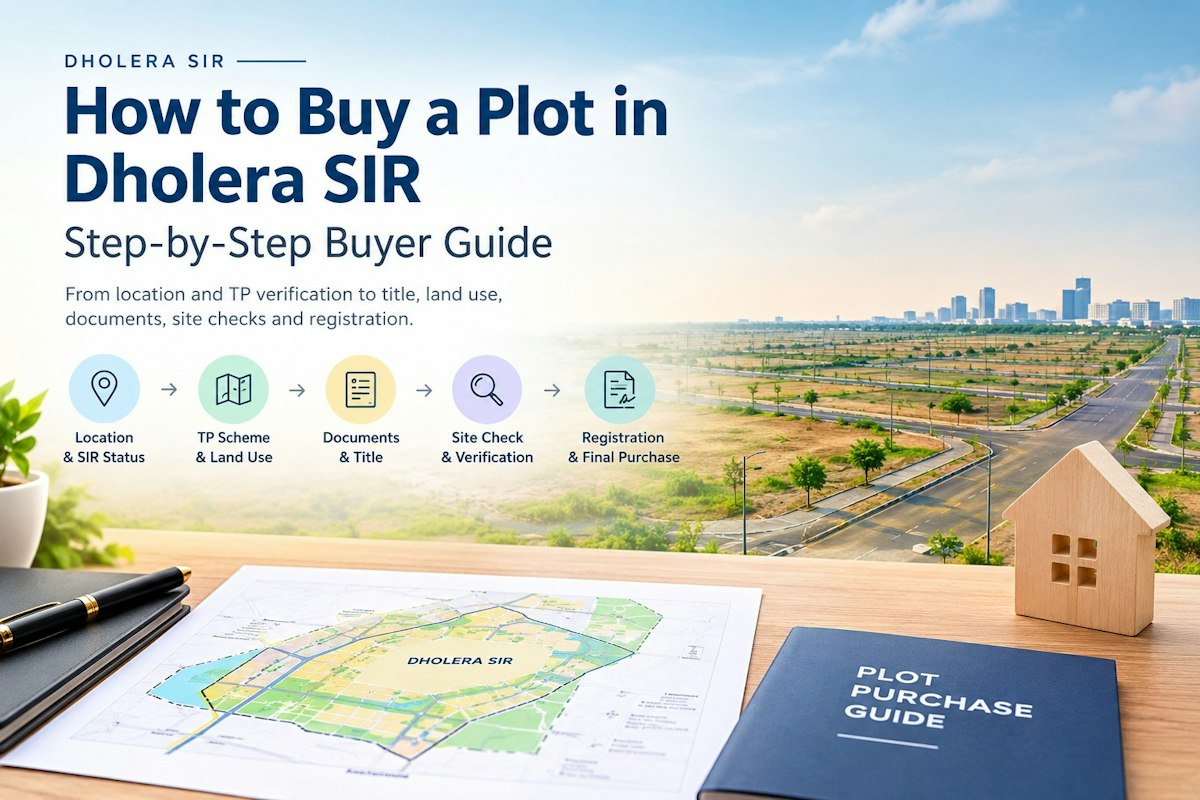
Buying a plot in Dholera SIR requires more than comparing prices per square yard. The same “Dholera plot” description can refer to properties with different locations, planning status, land-use classifications, road access and documentation.
A practical buying process therefore starts with identifying the exact property and ends only after the relevant documents, permissions and transaction details have been verified.
This guide explains the process step by step so that a first-time buyer can understand what to check before proceeding with a Dholera SIR plot.
1. Decide What You Want the Plot For
Start with the intended use.
Are you looking for:
- A future residential plot
- A long-term land holding
- A plot for a future home
- Commercial property
- An SCO plot
- Mixed-use property
- Industrial or logistics land
The answer matters because land-use permissions can differ between properties.
A residential buyer may prioritise neighbourhood conditions, plot dimensions, access roads and permitted residential development.
A commercial or SCO buyer may place greater importance on frontage, road width, visibility and the specific commercial uses permitted on the plot.
So the first question should not be:
“What is the cheapest plot?”
It should be:
“What am I legally permitted to do with this particular plot?”
2. Set the Total Purchase Budget
Do not calculate your budget using only the advertised plot price.
Depending on the transaction, the overall cost can include:
- Plot price
- Stamp duty
- Registration charges
- Documentation expenses
- Legal verification
- Professional fees
- Applicable government charges
- Development costs
- Future construction costs
Also consider whether you need financing or intend to purchase entirely from available funds.
A larger plot is not automatically the better fit if it creates unnecessary financial pressure.
3. Identify the Exact Location
This is one of the most important steps when buying a plot in Dholera.
“Dholera” covers a large region. A property advertisement using the word Dholera does not by itself establish the exact location or its relationship with Dholera SIR.
Before evaluating a property, record:
- Village
- Survey number
- Town Planning Scheme
- Final Plot number, where applicable
- Plot area
- Plot dimensions
- Road access
- Road width
- Surrounding development
- Distance from relevant infrastructure
Do not rely solely on a map pin supplied in a brochure.
The physical location should correspond with the property documentation.
4. Check Whether the Property Is Inside or Outside the Notified SIR Boundary
A property can be marketed as being “in Dholera,” “near Dholera SIR,” or “near Dholera Smart City” without necessarily being inside the notified Dholera SIR boundary. For a buyer specifically looking for a Dholera SIR plot, confirm the property's actual position against the relevant planning records.
This distinction is particularly important because properties inside and outside the SIR can have different planning frameworks, infrastructure context and development permissions.
5. Identify the Applicable Town Planning Scheme
If the property is within a TP scheme, identify the relevant scheme and sub-scheme.
The TP framework can provide important information about:
- Roads
- Land parcels
- Land use
- Final Plot arrangements
- Infrastructure
- Public-purpose reservations
- Development planning
Do not rely only on a salesperson's verbal description of a TP number. Ask for the relevant documentation and make sure the property being shown to you corresponds with the planning records.
For a deeper explanation of TP schemes, keep the dedicated Dholera TP Scheme guide as the supporting article rather than repeating its complete explanation here.
6. Verify the Survey Number and Final Plot Details
Once the location and TP scheme are established, check the property's identifying information. Depending on the property's planning stage, this can include:
- Original survey number
- Final Plot number
- Plot area
- Plot dimensions
- Boundaries
- Location within the scheme
- Relevant revenue records
The same identifying information should be consistent across the documents.
If the brochure says one plot number while the documentation shows another, stop and investigate the discrepancy before proceeding.
This is one of the most important differences between researching a plot online and actually buying one.
7. Confirm the Land-Use Classification
Next, establish what the property is legally intended for.
Depending on the property, the classification may relate to:
- Residential use
- Commercial use
- Mixed use
- SCO use
- Industrial use
- Logistics use
Do not assume that a plot can be used for whatever purpose the advertisement suggests.
For example, owning land does not automatically mean you can construct a residence, shop, office, warehouse or other structure on it.
The permitted use needs to be checked against the applicable planning documents and development regulations.
8. Check Ownership and Title
Before paying a substantial amount, establish who owns the property and whether the seller has the legal authority to transfer it.
Depending on the transaction, the document review may include:
- Title documents
- Previous ownership records
- Sale deeds
- Revenue records
- Survey details
- Relevant TP documentation
- Encumbrance-related records
- Applicable approvals
For a significant property transaction, independent legal review is advisable.
The purpose is not simply to collect documents.
The purpose is to establish that the property being sold is the same property described in those documents and that the seller can legally transfer it.
9. Verify NA Status Where Applicable
For land where Non-Agricultural permission is relevant, verify the actual status rather than relying on a brochure statement such as “NA approved” or “NA plot.”
Ask to see the applicable documentation.
Also verify that the document relates to the specific land parcel or survey details being purchased.
This is particularly important because buyers sometimes focus on the project-level claim without checking the individual property documentation.
10. Check the Approved Layout
The layout should be reviewed carefully.
Look for:
- Plot number
- Plot dimensions
- Road access
- Road width
- Open spaces
- Common areas
- Adjoining plots
- Reservations, where applicable
- Access to the plot
A plot advertised as “road-facing” should actually have the claimed road access in the relevant layout.
Likewise, a claimed wide-road frontage should be checked against the applicable plan rather than accepted solely from marketing material.
11. Inspect the Physical Property
Documents are essential, but a site inspection adds another layer of verification.
During a visit, look at:
- Actual approach road
- Existing road condition
- Plot boundaries
- Surrounding land
- Nearby construction
- Utility infrastructure
- Drainage
- Access from the main road
- Relationship between the advertised location and the actual site
If you cannot visit personally, ask for detailed site information and independent verification where practical.
This is especially useful when comparing properties that appear similar online.
12. Compare the Total Cost, Not Just the Rate
Two plots can have similar advertised prices but very different overall value for the buyer's intended purpose.
Compare:
- Total purchase price
- Price per square yard
- Plot size
- Road frontage
- Location
- Land-use category
- Documentation
- Infrastructure
- Registration costs
- Development requirements
Avoid making the decision solely on the lowest quoted rate.
A lower price can sometimes reflect differences in location, planning status, access or documentation.
13. Understand the Registration Process
Once the property has passed your due diligence, the transaction moves toward execution and registration.
The process generally involves documentation such as the agreement for sale, payment arrangements, sale deed execution and registration, followed by applicable mutation/revenue-record procedures.
The exact charges and procedures should be confirmed at the time of transaction because government rates and procedural requirements can change.
Your separate article on Dholera Plot Registration Process 2026 should handle the detailed stamp-duty and registration discussion.
That keeps this article focused on the complete buying journey instead of turning it into another registration guide.
14. Do Not Treat Future Infrastructure as Property Documentation
Dholera's infrastructure story is an important part of understanding the region, but future development should not replace property-level due diligence.
Infrastructure discussions may include:
- Expressway connectivity
- Airport development
- Industrial development
- Semiconductor manufacturing
- Logistics infrastructure
- Planned transport projects
These factors can help a buyer understand the broader location.
They do not, however, establish ownership, land use, title, plot boundaries or construction permissions for an individual property.
A useful rule is:
Infrastructure explains the location. Documents establish the property.
15. Common Mistakes to Avoid
Choosing only by price
The lowest price does not necessarily represent the most suitable property.
Assuming every Dholera plot is inside SIR
Always verify the exact boundary and location.
Relying on a brochure
Marketing material is useful for initial research, but important claims should be checked against documents.
Ignoring land use
Do not assume that every plot can be used for residential, commercial or mixed-use development.
Not checking the survey number
The survey number and other identifying details should correspond across the relevant documents.
Assuming a TP number guarantees everything
A TP scheme provides planning context, but the individual property's status and documentation still need to be checked.
Focusing only on future appreciation
No future price increase is guaranteed. The property should first make sense based on its present documentation, location and intended use.
A Simple Dholera Plot Buying Checklist
Before proceeding, ask these questions:
Location
- Where exactly is the plot?
- Which village?
- Which survey number?
- Is it inside or outside the notified SIR boundary?
Planning
- Which TP scheme applies?
- Is there a Final Plot number?
- What is the applicable land use?
Documents
- Who owns the property?
- Is the title clear?
- Are survey and plot details consistent?
- Is NA status applicable and documented?
- Are there known encumbrances?
Physical property
- Does the actual location match the documents?
- What is the road access?
- What is the actual plot size and frontage?
Development
- What can legally be constructed?
- What permissions are required?
- What infrastructure currently exists?
Transaction
- What is the complete purchase cost?
- What stamp duty and registration charges apply?
- What documents will be executed?
- Who will handle registration and mutation?
If these questions cannot be answered clearly, the buyer should pause before making the final commitment.
Frequently Asked Questions
Is buying a plot in Dholera SIR the same as buying any other plot?
No. The process still involves normal property due diligence, but buyers should additionally understand the applicable planning framework, TP scheme, land use and SIR status of the specific property.
How do I verify whether a plot is inside Dholera SIR?
Check the exact location and relevant planning/revenue records rather than relying solely on the property's marketing description.
What documents should I check before buying a Dholera plot?
Depending on the property, review ownership and title documents, survey details, relevant TP information, Final Plot details where applicable, land-use documentation, layout plans, approvals and encumbrance-related records.
Can I build a house on any plot in Dholera?
No. Construction depends on the property's permitted land use and the applicable development and building requirements.
Should I check the TP scheme before buying?
Yes. The applicable TP scheme can provide important planning context for roads, land parcels, Final Plot arrangements and development.
Is land outside Dholera SIR automatically unsuitable?
Not necessarily. But it should be evaluated under its actual planning and legal framework rather than being presented as equivalent to land inside the notified SIR.
Should I visit the property before buying?
A physical inspection can be useful for verifying access, surroundings, boundaries and the actual condition of the location.
What happens after due diligence?
Once the property and documents have been verified, the buyer can proceed with the transaction documentation and registration process. The exact procedure and applicable charges should be confirmed at the time of purchase.