How to Buy a Plot in Dholera SIR
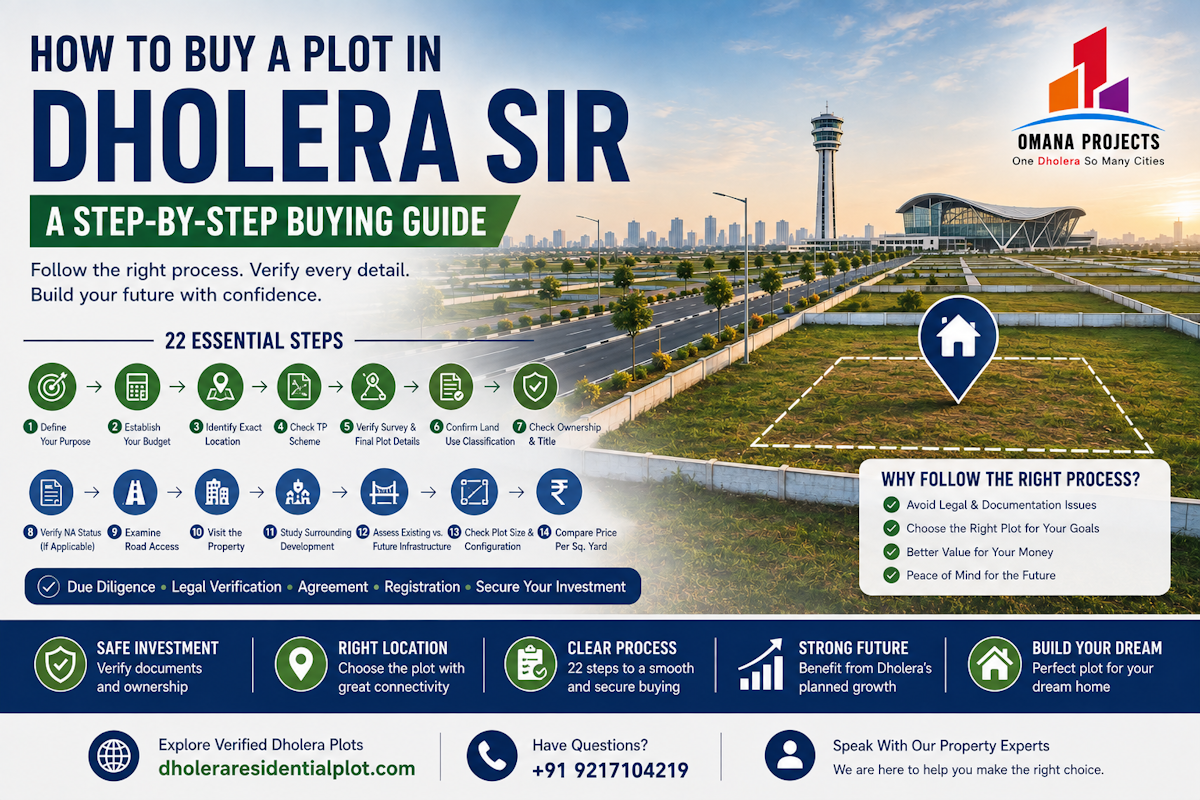
Buying a plot in Dholera SIR should not begin with the question, “What is the price per square yard?” A better approach is to first understand the property, its planning status, documentation, location and intended use.
Dholera is a large planned development region, so two plots carrying the same “Dholera” label can have very different characteristics. A disciplined buying process can help buyers compare properties more effectively and reduce the risk of making a decision based only on advertisements or future-development claims.
This guide covers the major steps a buyer can follow when evaluating Dholera SIR plots, from identifying the property to completing due diligence and registration.

Step 1: Define Your Purpose Before Searching
Start by deciding why you want to buy the plot.
Your objective could be:
- Building a future home
- Long-term land holding
- Residential investment
- Commercial activity
- Mixed-use development
- SCO-related commercial use
- Holding land as part of a broader property portfolio
Your purpose affects the type of plot you should consider.
For example, a buyer looking for a future residence may prioritise residential zoning, neighbourhood conditions, road access and plot configuration. A commercial buyer may place greater importance on frontage, visibility, road width and permitted commercial use.
First question to answer:
What do I actually intend to do with this property?
Step 2: Establish Your Total Budget
Do not calculate your budget using only the advertised plot price.
Consider the complete transaction cost, including potentially applicable:
- Plot purchase price
- Stamp duty
- Registration charges
- Documentation expenses
- Legal verification
- Professional fees
- Applicable taxes or government charges
- Development-related costs
- Future construction costs, if applicable
Also decide how much liquidity you want to retain after purchasing the land.
A plot should fit comfortably within your financial plan rather than being selected simply because the seller offers a larger area.
Step 3: Identify the Exact Location
This is one of the most important steps.
Do not evaluate a property simply because it is advertised as being “in Dholera.”
Record the:
- Village
- Locality
- Survey number
- Town Planning Scheme
- Final Plot number, where applicable
- Road access
- Road-facing position
- Nearby development
The exact location can make a substantial difference when comparing two properties.
Dholera is a region, not a single uniform property market.
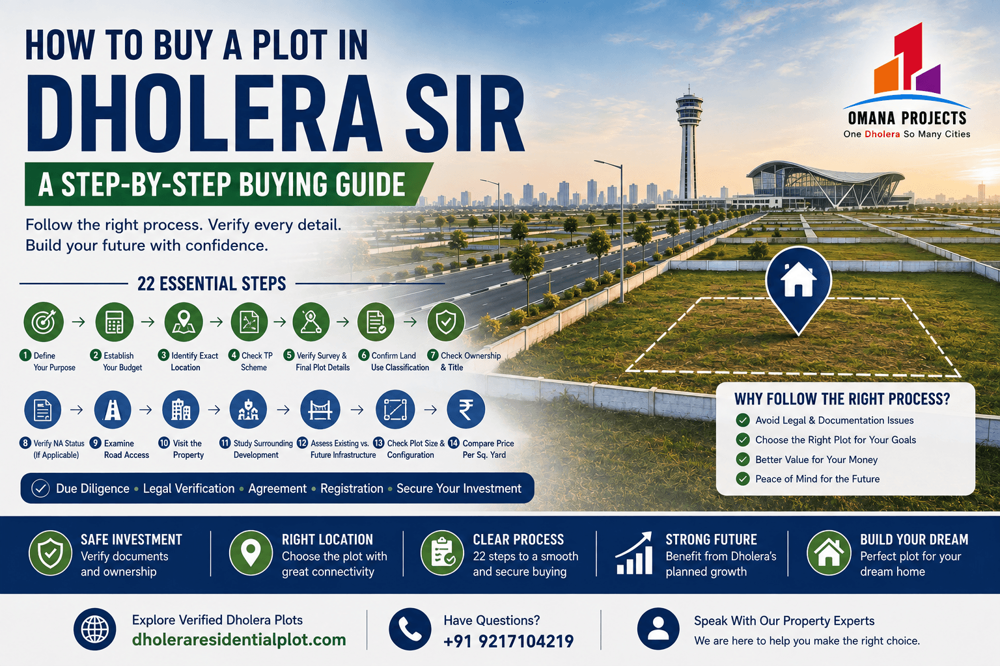
Step 4: Identify the Applicable TP Scheme
Once the location is established, determine which Town Planning Scheme applies to the property.
The TP Scheme can provide important planning context relating to:
- Roads
- Land use
- Final Plot arrangements
- Infrastructure
- Development structure
- Public-purpose areas
Do not rely only on a broker's verbal explanation.
Ask for the relevant planning information and verify that the property details correspond with the documentation.
For additional background, buyers can also read about Town Planning Schemes in Dholera SIR.
Step 5: Verify Survey and Final Plot Details
Where applicable, identify the property's:
- Original survey information
- Final Plot number
- Plot area
- Dimensions
- Boundaries
- Location within the applicable planning scheme
Check whether the information is consistent across the documents provided by the seller.
A mismatch between the advertised property and the documentation should be investigated before proceeding.
Step 6: Confirm the Land-Use Classification
This step is particularly important.
Determine what use is actually applicable to the property.
Depending on the property, buyers may encounter categories such as:
- Residential
- Commercial
- Industrial
- Mixed use
- SCO
- Other designated uses
Do not assume that a property can automatically be used for whatever purpose a salesperson describes.
If your intention is to construct a house, shop, office or other facility, verify that the intended activity is compatible with the applicable land-use classification and regulations.
Step 7: Check Ownership and Title
Before discussing final payment, verify who legally owns the property.
Depending on the transaction and applicable records, due diligence may include reviewing:
- Ownership records
- Title documents
- Revenue records
- Survey records
- Previous transaction documents
- Encumbrance information
- Sale deeds
- Applicable authority records
The objective is to establish a clear understanding of ownership and whether there are any issues affecting the proposed transaction.
For a significant land purchase, independent legal review is advisable.
Step 8: Verify NA Status Where Applicable
If the land originated as agricultural land, determine the applicable Non-Agricultural (NA) status and related documentation.
Do not assume that every plot marketed as a “residential plot” automatically has identical development permissions.
Ask for the relevant documentation and understand:
- Current land status
- Permitted use
- Applicable conversion
- Development restrictions
- Relevant approvals
The exact requirements can vary depending on the property and applicable regulations.
Step 9: Examine the Road Access
Road access is one of the most practical factors in plot evaluation.
Check:
- Existing road access
- Actual road width
- Documented road width
- Road-facing position
- Approach road
- Connectivity with surrounding roads
- Physical road condition
If a seller refers to a 70-metre road, proposed road or future corridor, verify exactly what that description means and whether the road currently exists, is approved, is under development or is only proposed.
Never value a plot entirely on a future road without verifying its planning status.
Step 10: Visit the Property Personally
A site visit should be treated as an essential part of the buying process.
During the visit, check:
- Exact plot location
- Road accessibility
- Plot boundaries
- Surrounding construction
- Nearby houses
- Commercial activity
- Industrial development
- Electricity infrastructure
- Water infrastructure
- Drainage conditions
- Neighbouring properties
- General accessibility
Take photographs and compare what you see with the seller's documents and property description.
Step 11: Check the Surrounding Development
Do not look only at the plot itself.
Study the surrounding area.
Ask:
- Are homes already being constructed?
- Are roads physically developed?
- Are businesses operating nearby?
- Is there existing infrastructure?
- Are neighbouring plots developed?
- What is the current level of activity?
- Are daily-use facilities accessible?
A plot surrounded by actual development can have very different practical characteristics from an isolated parcel, even if both have similar advertised prices.
Step 12: Separate Current Infrastructure From Future Plans
This is particularly important when evaluating property in a developing region.
Create three separate categories:
Existing
Infrastructure that is currently operational.
Under Development
Infrastructure that is actually being constructed or implemented.
Proposed
Infrastructure that remains part of future planning or proposals.
Do not treat all three categories as equivalent.
The Dholera International Airport, expressway, industrial projects and other regional infrastructure can provide useful context, but buyers should independently verify the current status of any project before using it as a major factor in their purchasing decision.
Step 13: Compare Plot Size and Configuration
Do not compare plots using area alone.
Record:
- Total area
- Frontage
- Depth
- Shape
- Corner position
- Road-facing side
- Access
- Setback considerations where relevant
A rectangular plot with useful frontage may be more practical for a particular purpose than a larger but poorly configured parcel.
The best configuration depends on the buyer's intended use.
Step 14: Compare Price Per Square Yard
Only after understanding the property should you compare pricing.
Calculate:
Total Plot Price ÷ Total Plot Area = Approximate Price Per Square Yard
But do not stop there.
Compare the price alongside:
- Location
- TP Scheme
- Final Plot status
- Road width
- Frontage
- Land use
- Surrounding development
- Documentation
- Accessibility
A cheaper plot is not necessarily better value.
Step 15: Compare Similar Properties
Create a simple comparison sheet.
| Factor | Plot A | Plot B | Plot C |
|---|---|---|---|
| Location | |||
| TP Scheme | |||
| Final Plot | |||
| Plot Size | |||
| Price | |||
| Price/Sq. Yard | |||
| Road Width | |||
| Land Use | |||
| Development | |||
| Documentation | |||
| Intended Use |
This prevents the cheapest property from automatically becoming the preferred property.
Step 16: Request the Complete Property Document Set
Before making a substantial financial commitment, ask the seller for the relevant documents.
Depending on the property, this may include:
- Title documents
- Ownership records
- Revenue records
- Survey details
- TP Scheme information
- Final Plot information
- Approved layout
- Land-use information
- NA documentation where applicable
- Road/access information
- Relevant permissions
- Previous transaction records
The exact documents required should be determined according to the property and transaction.
Step 17: Conduct Independent Legal Verification
This is where buyers should move beyond sales information.
An independent property lawyer can review the available documentation and help identify potential issues involving:
- Ownership
- Title
- Encumbrances
- Transferability
- Land classification
- Existing claims
- Documentation inconsistencies
- Applicable restrictions
The seller's explanation and legal verification serve different purposes.
Step 18: Verify the Seller or Developer
If purchasing through a developer or property company, research the entity separately.
Look at:
- Company identity
- Office details
- Track record
- Project information
- Documentation transparency
- Communication quality
- Ability to provide property-specific records
A professional seller should be able to explain the property without relying entirely on generic statements about Dholera's future.
Step 19: Avoid Paying Solely Because of Urgency
Be cautious with statements such as:
- “Price increases tomorrow.”
- “Only one plot is left.”
- “Book immediately.”
- “This road is definitely coming.”
- “Prices will double soon.”
- “Everyone is buying here.”
Urgency should never replace due diligence.
A legitimate opportunity should still withstand reasonable questions about title, planning, location and documentation.
Step 20: Review the Agreement Before Payment
Before making a major payment, understand exactly what you are purchasing.
Review:
- Property identification
- Plot area
- Boundaries
- Purchase price
- Payment schedule
- Seller details
- Buyer details
- Documentation
- Conditions of sale
- Registration requirements
- Applicable obligations
Do not sign documents that you do not understand.
Step 21: Complete the Registration Process Properly
Once due diligence is complete and both parties agree to proceed, follow the applicable legal process for executing and registering the transaction.
Ensure that the registered documentation accurately reflects:
- Buyer
- Seller
- Property
- Consideration
- Plot details
- Relevant identifiers
- Applicable terms
Keep copies of all executed and registered documents safely.
Step 22: Preserve Every Property Record
After purchase, maintain a complete property file.
Keep:
- Registered sale document
- Payment records
- Property documents
- Revenue records
- Planning documents
- Survey information
- Final Plot information
- Layout documents
- Correspondence
- Receipts
- Applicable approvals
Digital and physical copies can both be maintained for future reference.
A Simple Dholera Plot Buying Checklist
Before proceeding, ask yourself:
Location
- Have I identified the exact location?
- Have I visited the property?
Planning
- Do I know the applicable TP Scheme?
- Have I checked Final Plot information?
- Is the land-use classification clear?
Property
- Is the plot size correct?
- Are the dimensions suitable?
- Is the road access practical?
Infrastructure
- What infrastructure exists today?
- What is under development?
- What is only proposed?
Documentation
- Have I verified ownership?
- Have I checked title documents?
- Have I reviewed relevant land records?
- Have I checked NA status where applicable?
Financial
- Is the total purchase cost within my budget?
- Have I compared price per square yard?
- Have I compared genuinely similar properties?
Legal
- Has the documentation been independently reviewed?
- Do I understand the transaction before signing?
Purpose
- Does this plot actually match my intended use?
- Am I comfortable with my expected holding period?
Common Mistakes Buyers Should Avoid
Buying only because the price is low
Low price can be attractive, but it should trigger more questions—not fewer.
Assuming every Dholera plot is the same
Location, planning, access and documentation can vary considerably.
Treating proposed infrastructure as operational
Always establish the actual development status.
Ignoring TP Scheme information
Planning information can be highly relevant to understanding a property's characteristics.
Skipping the site visit
Online listings cannot show every practical feature of a property.
Relying entirely on verbal assurances
Important property information should be supported by appropriate documentation.
Comparing only price per square yard
Price is one factor within a much larger property proposition.
Making a rushed decision
Land is a substantial financial commitment. Due diligence should come before urgency.
Final Takeaway
Buying a plot in Dholera SIR should be approached as a Dholera SIR Plot-verification process, not simply as a search for the lowest price.
The basic sequence is:
Define your objective → establish your budget → identify the exact location → verify the TP Scheme → check Final Plot details → confirm land use → verify ownership and title → examine road access → visit the site → assess surrounding development → separate current infrastructure from future proposals → compare prices → conduct legal due diligence → review the agreement → complete registration → preserve the records.
The strongest purchase decision is not necessarily the plot with the lowest price. It is the property whose location, planning status, permitted use, accessibility, documentation, price and long-term purpose make sense together.