Dholera Activation Area vs Entire SIR: What Is Actually Developed in 2026?
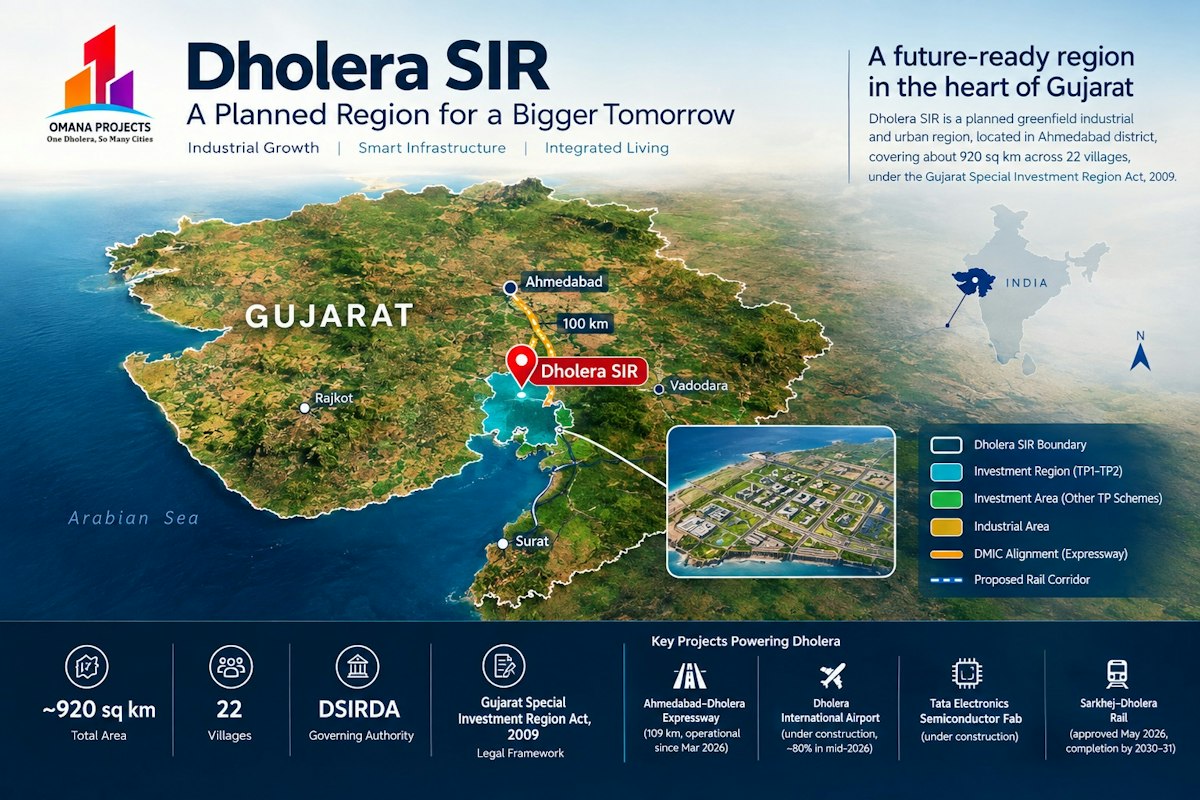
If you search for Dholera SIR today, you will find photographs of wide roads, underground utilities, the ABCD Building, industrial projects and other infrastructure. But there is an important detail that property buyers should understand:
Those developments do not mean that the entire 920 sq km Dholera SIR has the same level of infrastructure.
Dholera SIR is a large planned region of approximately 920 sq km. Within it, a much smaller 22.54 sq km Phase-I Activation Area was selected for early trunk infrastructure and industrial development. NICDC currently describes this Activation Area as almost completed, with trunk infrastructure in place.
A property located close to developed infrastructure may have a very different practical situation from another property elsewhere in the wider Dholera region.
So, what exactly is the Activation Area, what has been developed there, and what should buyers verify before assuming that a plot has access to the same infrastructure?
What Is the Dholera Activation Area?
The Activation Area is the initial infrastructure-focused portion of Dholera SIR selected to trigger industrial and other development. Government of India's original project plan approved trunk infrastructure for an area of approximately 22.5 sq km in Phase I of Dholera SIR.
The planned infrastructure included:
Roads and services
ABCD Building
Water Treatment Plant
Sewage Treatment Plant
Common Effluent Treatment Plant
Power and utility infrastructure
Drainage and other supporting services
The purpose was not to develop the entire 920 sq km simultaneously. Instead, the Activation Area was intended to provide a serviced base from which further development could expand.
That is why the word “activation” is important.
It refers to an area intended to help activate the larger planned region.
22.5 Sq Km vs 920 Sq Km: The Difference Buyers Must Understand
The simplest way to understand Dholera's scale is to compare the two numbers.
Area | Approximate size | What it represents |
Dholera SIR | 920 sq km | Overall planned Special Investment Region |
Phase-I Activation Area | 22.54 sq km | Initial trunk-infrastructure development area |
The Activation Area therefore represents only a small portion of the overall SIR.
Government documents have previously described the Activation Area as approximately 22.5 sq km within the larger 920 sq km region. The original planning documents also explain that it was selected as a catalyst for subsequent development.
This is one of the most important facts for anyone researching Dholera property.
“Inside Dholera SIR” does not automatically mean “inside the Activation Area.”
What Infrastructure Is in the Activation Area?
The Activation Area was planned around trunk infrastructure rather than isolated projects.
This includes the underlying systems needed for an industrial city, such as:
Roads
Roads form the basic framework for connecting industrial, commercial, residential and utility areas.
The original government project documents planned roads and associated services within the Activation Area and wider town-planning schemes.
Water
Water infrastructure is essential for both industrial and urban development.
The Phase-I trunk infrastructure programme included a Water Treatment Plant and associated water-supply services.
Sewerage
A planned industrial city requires wastewater collection and treatment rather than relying only on conventional local systems.
The Activation Area's original infrastructure package included sewage treatment infrastructure.
Effluent Treatment
Industrial development also requires systems for managing industrial effluent.
The original Phase-I package included a Common Effluent Treatment Plant (CETP).
Power and Utilities
Power, telecom, drainage and other services were planned alongside roads and underground utility corridors.
The government documentation specifically describes services including storm-water drainage, water supply, sewerage, power, telecom and gas in the town-planning infrastructure framework.
Is the Activation Area Developed in 2026?
There is an important difference between saying “Dholera is developed” and saying “the Activation Area has trunk infrastructure.”
NICDC's current Dholera project page describes the 22.54 sq km Activation Area as almost completed, with trunk infrastructure in place.
A 2026 government industrial-corridor document also describes the 22.5 sq km Phase-I Activation Area as having trunk infrastructure works nearing completion, with ₹2,784.83 crore approved across five infrastructure packages.
This provides a much more precise description of Dholera's current development status than simply calling the whole 920 sq km region “developed.”
What About the Rest of Dholera SIR?
The remaining area is part of the larger planned Dholera SIR and is intended to develop progressively.
The broader master plan includes different land-use categories and town-planning schemes, including industrial, residential, logistics, public facilities, recreation and other uses.
Therefore, development should be viewed as a phased process, rather than a situation where every part of Dholera receives infrastructure at exactly the same time.
This distinction is particularly important when a property advertisement uses phrases such as:
“Dholera SIR plot”
“Near Dholera Smart City”
“Near Activation Area”
“Dholera industrial corridor”
“Future development zone”
These descriptions can refer to very different locations.
Why Does the Activation Area Matter to Plot Buyers?
For a plot buyer, the most useful question is not simply:
“Is this plot in Dholera?”
A better question is:
“What infrastructure and planning status applies to this exact plot?”
For example, two properties could both be marketed as being in the Dholera region while having different:
Distances from trunk infrastructure
Road access
Planning status
Land-use designations
Utility availability
Development timelines
Approval requirements
That is why buyers should examine the exact location rather than relying only on the name “Dholera.”
Activation Area Does Not Mean Every Nearby Plot Has the Same Status
Being geographically close to the Activation Area does not automatically make a private plot part of the Activation Area. Similarly, a plot being marketed as “near the Activation Area” does not mean it has direct access to every utility or road inside it.
Buyers should verify the exact plot's:
Survey number
Final Plot number, where applicable
Town Planning Scheme
Land-use designation
Road access
Development permissions
Utility availability
Distance from existing infrastructure
This is more reliable than judging a property based on a marketing map or approximate distance.
How Do TP Schemes Fit Into the Picture?
Dholera's larger planning structure includes Town Planning Schemes. The original government planning documents identify TP1 and TP2 as major town-planning areas, with road networks and utilities intended to be developed progressively. The Activation Area was carved out as an initial serviced portion to act as a catalyst for wider development.
This means buyers should not treat:
SIR → Activation Area → TP Scheme → Plot
as interchangeable terms.
They describe different levels of the planning structure.
Understanding the exact relationship between them can help buyers avoid confusing a broad regional boundary with the infrastructure status of an individual property.
What Has Attracted Industry to the Activation Area?
One reason the Activation Area receives so much attention is that it was designed to provide infrastructure capable of supporting industrial investment.
Government documents show that industrial plots have already been allotted within Dholera, including major anchor investments. A 2025 DPIIT document recorded Tata Electronics' 164-acre allotment for its semiconductor wafer fabrication project, alongside other industrial allotments.
NICDC currently lists sectors such as:
Semiconductors
Aerospace and defence
Solar component manufacturing
Green hydrogen
Pharmaceuticals and biotechnology
Heavy engineering
among the focus sectors for Dholera.
This is why the Activation Area is more than just a road-development project.
It is intended to form part of the industrial foundation of the wider SIR.
Does the Activation Area Mean Dholera Is Already a Complete City?
No.
This is where property marketing can sometimes create confusion.
Dholera is being developed as a large planned industrial city and region, but different parts are at different stages of development.
The Activation Area has received concentrated infrastructure investment, while the larger 920 sq km region represents a much longer-term development framework.
Therefore, buyers should not expect every part of the SIR to have:
The same road quality
The same utility availability
The same level of construction
The same commercial activity
The same social infrastructure
The same development timeline
What Should Buyers Check Before Buying a Dholera Plot?
If a seller tells you that a plot is “inside Dholera SIR” or “near the Activation Area,” ask for documents that allow you to verify the claim.
1. Exact location
Get the precise survey number and location rather than relying on a pin dropped on a general map.
2. Town Planning Scheme
Check which TP scheme applies to the property. Visit here
3. Land use
Confirm whether the land is designated for residential, commercial, industrial, logistics or another permitted use.
4. Road access
Do not assume that a wide road visible elsewhere in Dholera directly serves your plot.
Check the actual road connecting to the property.
5. Utilities
Ask whether water, power, sewerage and other services are already available at the plot or are only planned for the broader area.
6. Development permissions
Check the permissions applicable to the specific land parcel.
7. Title and land records
Infrastructure potential does not replace legal due diligence.
Review ownership, title and relevant revenue records before making a purchase decision.
8. Actual distance
Instead of accepting phrases such as “five minutes from the Activation Area,” measure the route to the actual infrastructure or project you are interested in.
Activation Area vs Wider SIR: A Simple Comparison
Factor | Activation Area | Wider Dholera SIR |
Approximate size | 22.54 sq km | 920 sq km |
Development approach | Initial concentrated infrastructure | Larger phased development |
Trunk infrastructure | Almost completed / in place according to NICDC | Development varies by location and phase |
Industrial focus | Strong | Multiple planned land uses |
Utilities | Concentrated infrastructure network | Availability varies by location |
Buyer consideration | Verify exact plot connection | Verify development phase and planning status |
NICDC's current description supports the distinction between the developed Activation Area and the much larger planned SIR.
What Does “Dholera Development” Actually Mean in 2026?
A more accurate description is:
Dholera has an established infrastructure core within its Phase-I Activation Area, while the wider 920 sq km SIR remains a large phased development region.
That distinction is much more useful than simply saying Dholera is either “fully developed” or “not developed.”
It also explains why buyers can see substantial infrastructure on a site visit while still finding undeveloped land elsewhere in the wider Dholera region.
Both observations can be true.
Frequently Asked Questions
What is the Dholera Activation Area?
The Dholera Activation Area is the approximately 22.54 sq km Phase-I area selected for concentrated trunk infrastructure and early development within the larger 920 sq km Dholera SIR.
How large is Dholera SIR?
The Dholera Special Investment Region covers approximately 920 sq km.
How large is the Dholera Activation Area?
The Activation Area is approximately 22.54 sq km, commonly rounded to 22.5 sq km.
Is the entire Dholera SIR developed?
No. The broader SIR is a much larger planned region being developed in phases. The initial infrastructure concentration has been in the Activation Area.
Is infrastructure available in the Activation Area?
NICDC currently describes the Activation Area as almost completed, with trunk infrastructure in place.
Does every Dholera plot have access to Activation Area infrastructure?
No. Buyers should verify the exact plot location, road access, land-use status and actual utility availability rather than assuming that infrastructure elsewhere in Dholera automatically serves the property.
Is a plot outside the Activation Area necessarily a bad investment?
Not necessarily. The important issue is the specific property's planning status, permitted use, access, infrastructure and development context. A location outside the Activation Area should be evaluated on its own facts rather than simply labelled good or bad.
Bottom Line
The Dholera Activation Area is one of the most important concepts for understanding Dholera property in 2026.
The key numbers are simple:
920 sq km = overall Dholera SIR
22.54 sq km = Phase-I Activation Area
The Activation Area was selected to receive concentrated trunk infrastructure and act as a catalyst for wider development. NICDC currently describes its trunk infrastructure as almost complete, while the broader SIR remains a much larger, phased development region.
For plot buyers, the practical lesson is straightforward:
Do not buy based on the word “Dholera” alone.
Check the exact location, TP scheme, land use, road access, utilities, development permissions and legal documents.
That is the difference between understanding Dholera's development map and simply following the marketing around it.
Looking for a Dholera Property and want to understand its location, planning status and documentation before buying? Explore Omana Projects and speak with the team about location, documentation and availability.