Dholera Plot Charges After Purchase: What to Ask

Most buyers budget for the price per square yard, stamp duty and registration. Fewer ask what comes after. In a planned region like Dholera, where land is organised through town planning schemes and infrastructure is built in phases, several other charges can appear before or after you build. This guide explains the categories, what we could and could not confirm, and the questions to put in writing before you pay. It is general information, not legal or tax advice.
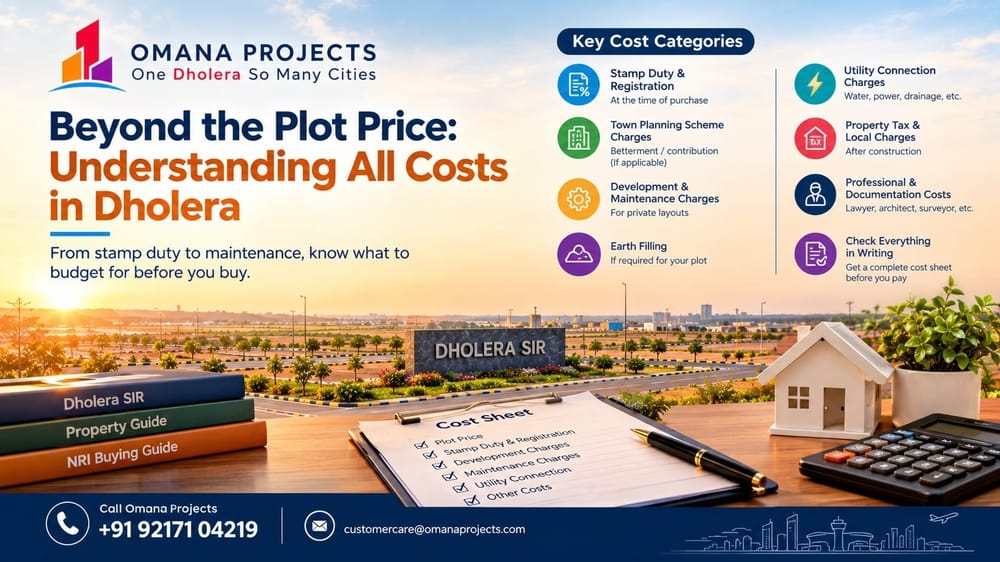
Charges at Purchase Versus Charges After
At purchase, you typically pay stamp duty and a registration fee. Figures of about 4.9% and 1% are commonly cited for Gujarat, and TDS may apply on higher-value deals. Our guide to the Dholera Plot Registration Process and Stamp Duty covers these.
After purchase, costs depend on the plot’s location, the project and the stage of development. These are the ones buyers most often miss.
Charges Linked to the Town Planning Scheme
Dholera’s land is organised under town planning schemes governed by the Gujarat Town Planning and Urban Development Act, 1976. In a scheme, original land parcels are reconstituted into final plots, and a share of land is set aside for roads, public amenities and the authority. Planning consultants describing one of the Dholera schemes noted the creation of large plot appropriations so the authority can raise resources for public infrastructure.
Under this kind of system, owners may also be asked to bear part of the cost of infrastructure, commonly through a betterment charge determined for the scheme. We did not find a published rate card for Dholera’s schemes, so do not rely on a seller’s verbal figure. Ask whether the final plot you are buying has any such charge outstanding, and ask for the answer in writing. For how original plots become final plots, see Survey Number vs Final Plot Number in Dholera.
Development and Maintenance Charges in Private Layouts
Some layouts charge a separate development fee, a maintenance charge or both, payable at booking, on possession or years later. Ask:
What exactly does the charge cover, such as internal roads, drainage or common areas?
When is it due, and is it fixed or revisable?
Who maintains the layout in the meantime?
What happens if it is not paid?
Earth Filling
Dholera is flat and low-lying, and ground levels matter. The official Dholera FAQ states that, in the Activation Area, 1.5 to 2 metres of earth filling is required and is to be done by the project proponent. It adds that if land is received already filled, additional charges are payable. For a private plot, ask whether filling is needed, who pays and whether it is included in the price.
Utility Connection Charges
Utility networks have been developed in the Activation Area, but connecting your own plot usually involves application fees, deposits or connection charges set by each service provider. Ask what is available at your boundary today and what you will need to pay to connect.
Taxes and Local Charges After Construction
Once you build, property tax or local charges may apply. Ask DSIRDA or your lawyer what applies to your plot, and when.
Professional and Documentation Costs
Budget for a lawyer’s fee for title checks, an architect, a surveyor if you want boundaries confirmed, and certified copies of records. These are small compared with the plot but easy to forget.
What We Could Not Confirm
A published betterment or contribution schedule for specific Dholera schemes
A standard development charge for private layouts
Standard connection charges for each utility
If a seller quotes a figure, ask for the source.
A Written Cost Sheet Checklist
Before you pay a booking amount, ask for a single sheet that lists:
Plot price and area, in the units used in the sale deed
Stamp duty, registration and TDS assumptions
Any development, maintenance or betterment charges, with due dates
Earth filling status and cost
Utility connection arrangements
Any refund or cancellation terms
Compare it with the booking agreement, and have your lawyer review both. Our step-by-step buying guide shows where this fits in the process.
Frequently Asked Questions
Is Stamp Duty the Only Cost After Buying a Plot?
No. Depending on the plot, there can also be development, maintenance, earth filling, utility and legal costs.
What Is a Betterment Charge?
A charge that owners may be asked to bear for infrastructure improvements within a town planning scheme. Ask whether any applies to your final plot.
Who Pays for Earth Filling?
It depends on the plot and agreement. In the Activation Area, the official FAQ says it is done by the project proponent, with extra charges if land is received already filled.
Can a Seller Add Charges Later?
Only as agreed in your documents. Get every charge and due date written in the agreement.
Bottom Line
A plot’s real cost is the price plus everything that follows. Ask for a written cost sheet, confirm what applies to your final plot and keep every answer in writing.
Want a clear cost breakdown for a plot? Call Omana Projects on +91 92171 04219 or email customercare@omanaprojects.com.